Alpha Lactalbumin Market Set to Reach USD 1,512.6 Million by 2035, Driven by Infant Nutrition and 7.4% CAGR
The alpha lactalbumin market is projected to reach USD 1,512.6 million by 2035 at a 7.4% CAGR, led by infant nutrition
Press Release Disclaimer: This is a press release distributed through the XPR Media network. It has not been independently verified by our newsroom.
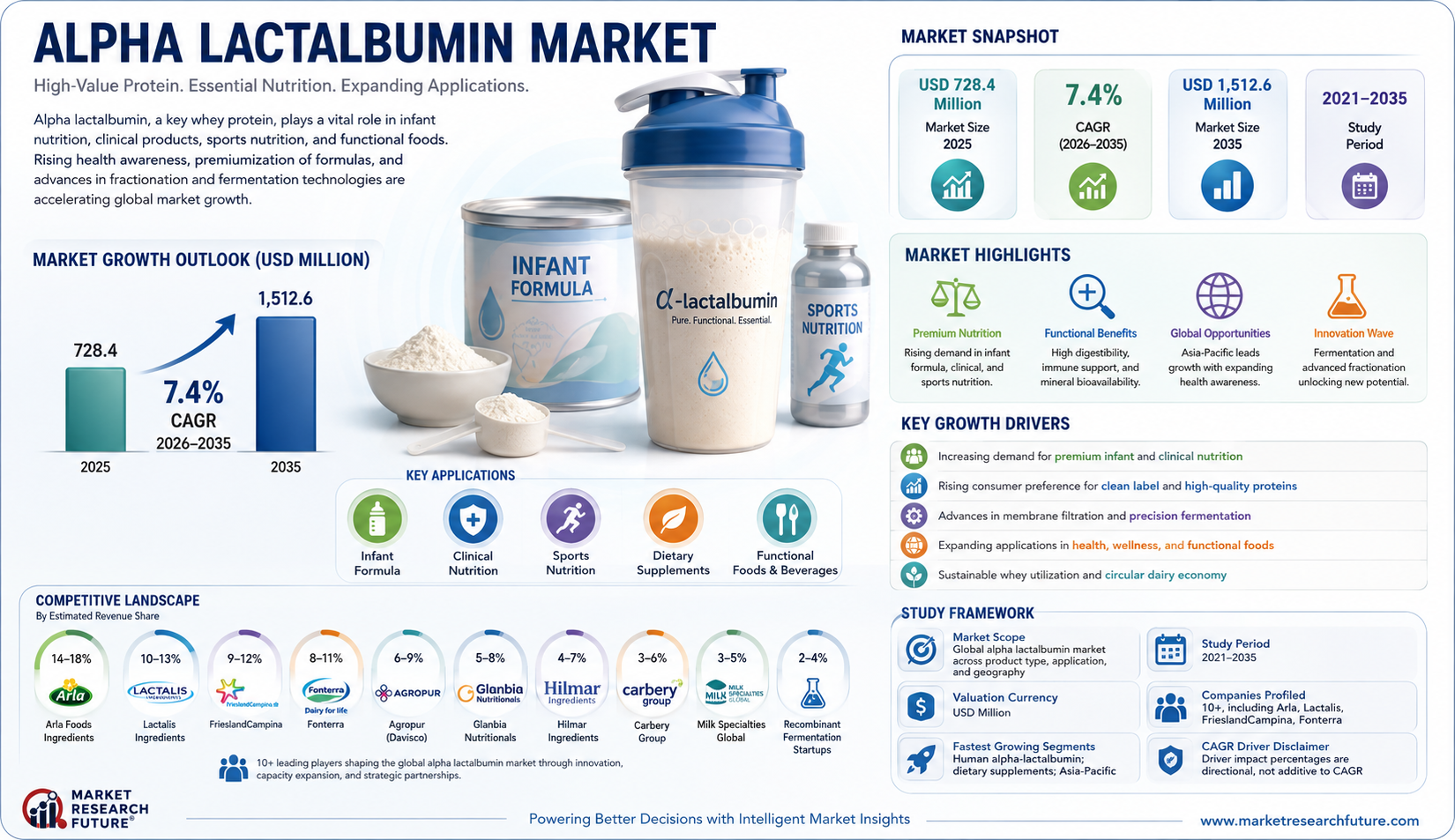

The alpha lactalbumin market is projected to reach USD 1,512.6 million by 2035 at a 7.4% CAGR, led by infant nutrition and Asia-Pacific demand.
NEW YORK, NY, UNITED STATES, August 27, 2026 /EINPresswire.com/ —
The global alpha lactalbumin market is entering a period of sustained expansion as nutrition manufacturers increasingly seek high-quality proteins that can improve amino-acid profiles, support specialized formulations, and more closely replicate the protein composition of human milk. Alpha-lactalbumin is particularly important in early-life nutrition because it is the predominant whey protein in human milk and contains substantial levels of essential amino acids, including tryptophan. Research also indicates that alpha-lactalbumin has potential applications across sports nutrition, functional foods, medical nutrition, and healthy-aging products.
The competitive landscape is led by established dairy-ingredient companies with access to whey streams, fractionation capabilities, purification technologies, and global nutrition customers. Based on the supplied market assessment, Arla Foods Ingredients holds an estimated 14–18% revenue share range, followed by Lactalis Ingredients at 10–13%, FrieslandCampina at 9–12%, and Fonterra at 8–11%. Agropur (Davisco), Glanbia Nutritionals, Hilmar Ingredients, Carbery Group, and Milk Specialties Global form additional competitive layers. Meanwhile, recombinant fermentation startups, estimated at 2–4%, represent an emerging technology-driven segment that could alter the industry’s supply structure over the longer term. Arla’s portfolio specifically positions alpha-lactalbumin for low-protein infant formulas and early-life nutrition applications.
Free Sample Copy – Access A Complimentary Copy of Our Report to Explore Its Content and Insights
https://www.marketresearchfuture.com/sample_request/38465
Market Size and Growth Outlook
According to the supplied market assessment, the global alpha lactalbumin market was valued at USD 728.4 million in 2025 and is projected to reach USD 1,512.6 million by 2035, expanding at a 7.4% CAGR from 2026 to 2035. The study covers the market across product type, application, and geography during the 2021–2035 study period. The growth trajectory reflects increasing demand for premium protein ingredients, expansion of infant formula manufacturing, greater interest in functional nutrition, and continued research into the biological properties of alpha-lactalbumin.
Product Type: Human and Bovine Alpha-Lactalbumin
Human alpha-lactalbumin represents the faster-growing product category because of its close biological relevance to human milk. Its potential use in advanced infant nutrition and precision-fermented dairy alternatives makes it strategically important for manufacturers seeking proteins that reproduce specific nutritional characteristics without depending entirely on conventional dairy production. However, regulatory acceptance, production economics, purity, scalability, and consumer acceptance remain important commercialization considerations.
Bovine alpha-lactalbumin currently represents the established commercial foundation of the industry. It is recovered from bovine whey through specialized separation and fractionation processes and is incorporated into infant formula, nutritional powders, clinical nutrition products, and specialized protein formulations. Its established supply chains and manufacturing infrastructure give bovine alpha-lactalbumin a significant near-term advantage.
Application Analysis
Infant formula remains the central application segment. Alpha-lactalbumin enables manufacturers to formulate products with a protein composition closer to human milk while maintaining essential amino-acid requirements. It is particularly relevant to low-protein formulas, where protein quality becomes more important as overall protein concentration is reduced. Studies and industry research have associated alpha-lactalbumin-enriched formulations with nutritional adequacy and digestive-tolerance considerations, although product-specific clinical outcomes vary.
Dietary supplements are expected to become an increasingly relevant growth segment as consumers move toward specialized proteins rather than conventional bulk protein sources. Alpha-lactalbumin’s amino-acid profile and high tryptophan content have generated interest in recovery, cognitive wellness, and sleep-related nutrition. However, evidence is still developing. A 2025 randomized crossover study found that seven days of pre-sleep alpha-lactalbumin supplementation did not improve habitual sleep or physical performance among athletes with mild-to-moderate sleep difficulties, highlighting the need for careful scientific substantiation of product claims.
Medical and clinical nutrition offers another specialized opportunity. Protein formulations for older adults, patients with elevated nutritional requirements, and individuals requiring targeted dietary support can benefit from highly digestible, nutritionally dense proteins. The segment is likely to favor ingredients with consistent purity, documented functionality, and reliable supply.
Functional food and beverages represent a broader but more formulation-sensitive opportunity. Alpha-lactalbumin can be incorporated into protein beverages, nutritional powders, bars, and other products where manufacturers want to differentiate through protein quality. Texture, solubility, flavor, processing stability, and ingredient cost will influence adoption.
Regional Analysis
Asia-Pacific is projected to be the fastest-growing regional market, supported by the expansion of infant nutrition manufacturing, rising disposable incomes, urbanization, and growing demand for specialized nutritional products. The region’s importance is further strengthened by its large consumer base and increasing sophistication of infant-formula and dietary-supplement categories.
Europe remains a strong production and innovation center because of its established dairy-processing infrastructure and concentration of specialty ingredient manufacturers. Companies such as Arla Foods Ingredients, Lactalis Ingredients, and FrieslandCampina benefit from integrated dairy supply chains and technical expertise.
North America represents an important market for whey fractions, sports nutrition, dietary supplements, and specialized nutritional formulations. Companies including Agropur, Hilmar Ingredients, Glanbia Nutritionals, and Milk Specialties Global contribute to the region’s production and formulation capabilities.
Latin America and the Middle East & Africa are developing markets where growth will depend on expansion in nutrition products, dairy processing, healthcare nutrition, and modern retail channels. Supply-chain economics and regulatory requirements will remain important factors influencing market penetration.
Key Companies and Strategic Positioning
Arla Foods Ingredients maintains a strong competitive position through advanced whey fractionation and a dedicated early-life nutrition portfolio. Its alpha-lactalbumin products are designed for applications including humanization, low-protein formulas, and digestive comfort.
Lactalis Ingredients benefits from global dairy scale and integration across whey fractions and infant nutrition. FrieslandCampina is positioned around humanized whey proteins and has strong access to Asian nutrition markets. Fonterra benefits from its Oceania dairy supply base and bovine alpha-lactalbumin capabilities.
Agropur (Davisco) and Hilmar Ingredients bring North American whey-processing strength, while Glanbia Nutritionals emphasizes functional protein solutions and sports nutrition. Carbery Group focuses on specialty whey proteins and clinical nutrition applications, while Milk Specialties Global provides bioactive whey fractions for specialized nutrition markets.
Industry Developments
1. Precision-fermented alpha-lactalbumin moves closer to commercialization. In December 2025, Dyadic and BRIG BIO announced a development and commercialization agreement for recombinant bovine alpha-lactalbumin. The collaboration aims to develop scalable, animal-free production for early-life, active, healthy-aging, and medical nutrition applications. In 2026, the companies initiated scale-up activities under the funded program.
2. Recombinant dairy proteins expand beyond individual pilot programs. Dyadic has continued expanding its precision-fermentation pipeline, using its Dapibus platform to develop non-animal dairy proteins and enzymes. The company’s progress with recombinant bovine alpha-lactalbumin indicates that fermentation-based production is moving from technology development toward commercial-scale process development.
Technology, Supply Chain and Market Opportunities
The industry’s next competitive phase is likely to center on purity, yield, cost efficiency, traceability, and formulation performance. Traditional alpha-lactalbumin production depends on dairy and whey availability, making access to high-quality raw material strategically important. Fractionation technology can increase the value recovered from whey, but processing complexity can affect production costs.
Precision fermentation introduces a different supply model. Instead of extracting alpha-lactalbumin from milk, microorganisms can be engineered to produce targeted proteins. If manufacturers achieve competitive fermentation yields, purification efficiency, regulatory approvals, and acceptable economics, recombinant alpha-lactalbumin could complement conventional dairy-derived supply. The technology may also provide greater consistency and reduce dependence on agricultural supply fluctuations.
At the same time, scientific validation will remain essential. Reviews have identified potential applications involving gut health, metabolism, muscle, oxidative stress, cognition, and sleep, but researchers emphasize that some findings remain based on cellular or animal studies and require stronger human evidence.
Market Outlook
The alpha lactalbumin market is positioned at the intersection of infant nutrition, specialty dairy ingredients, precision fermentation, and personalized nutrition. Infant formula will remain the principal demand engine, while dietary supplements, medical nutrition, and functional foods provide diversification. Asia-Pacific is expected to offer significant incremental demand, whereas Europe and North America will continue to provide technology, manufacturing, and formulation expertise.
The 7.4% CAGR through 2035 reflects a market moving beyond conventional whey processing toward higher-value protein fractions and application-specific nutrition. The projected increase from USD 728.4 million in 2025 to USD 1,512.6 million in 2035 will depend on continued innovation, regulatory progress, supply reliability, and the ability of manufacturers to demonstrate measurable nutritional and functional value.
Note: Driver impact percentages, where applicable, are directional and should not be interpreted as additive components of the stated CAGR.
FAQ
1. What is driving the alpha lactalbumin market?
The major drivers include demand for humanized infant formula, low-protein formulations, premium whey fractions, dietary supplements, clinical nutrition, and growing research into alpha-lactalbumin’s functional properties.
2. Which segment is expected to grow fastest?
Human alpha-lactalbumin, dietary supplements, and Asia-Pacific are identified as the fastest-growing segments, supported by precision fermentation, specialized nutrition demand, and expanding regional consumption.
Read Our Related Research Report
Lactobionic Acid Market –
https://www.marketresearchfuture.com/reports/lactobionic-acid-market-30547
Lactose Free Food Market –
https://www.marketresearchfuture.com/reports/lactose-free-food-market-1602
Lactase Market –
https://www.marketresearchfuture.com/reports/lactase-market-10401
Lactose-Free Butter Market –
https://www.marketresearchfuture.com/reports/lactose-free-butter-market-10677
Lactose-Free Probiotic Yogurt Market –
https://www.marketresearchfuture.com/reports/lactose-free-probiotic-yogurt-market-24788
Sagar Kadam
Market Research Future
+1 628-258-0071
email us here
Legal Disclaimer:
EIN Presswire provides this news content “as is” without warranty of any kind. We do not accept any responsibility or liability
for the accuracy, content, images, videos, licenses, completeness, legality, or reliability of the information contained in this
article. If you have any complaints or copyright issues related to this article, kindly contact the author above.

Media gallery