Bud Ecosystem Launches Bud GPU Foundry, an Open-Source Control Plane That Turns GPU Fleets Into Cloud Services
Licensed under Apache 2.0, it lets neoclouds and sovereign operators sell bare metal, VMs, Kubernetes, SLURM and
Press Release Disclaimer: This is a press release distributed through the XPR Media network. It has not been independently verified by our newsroom.
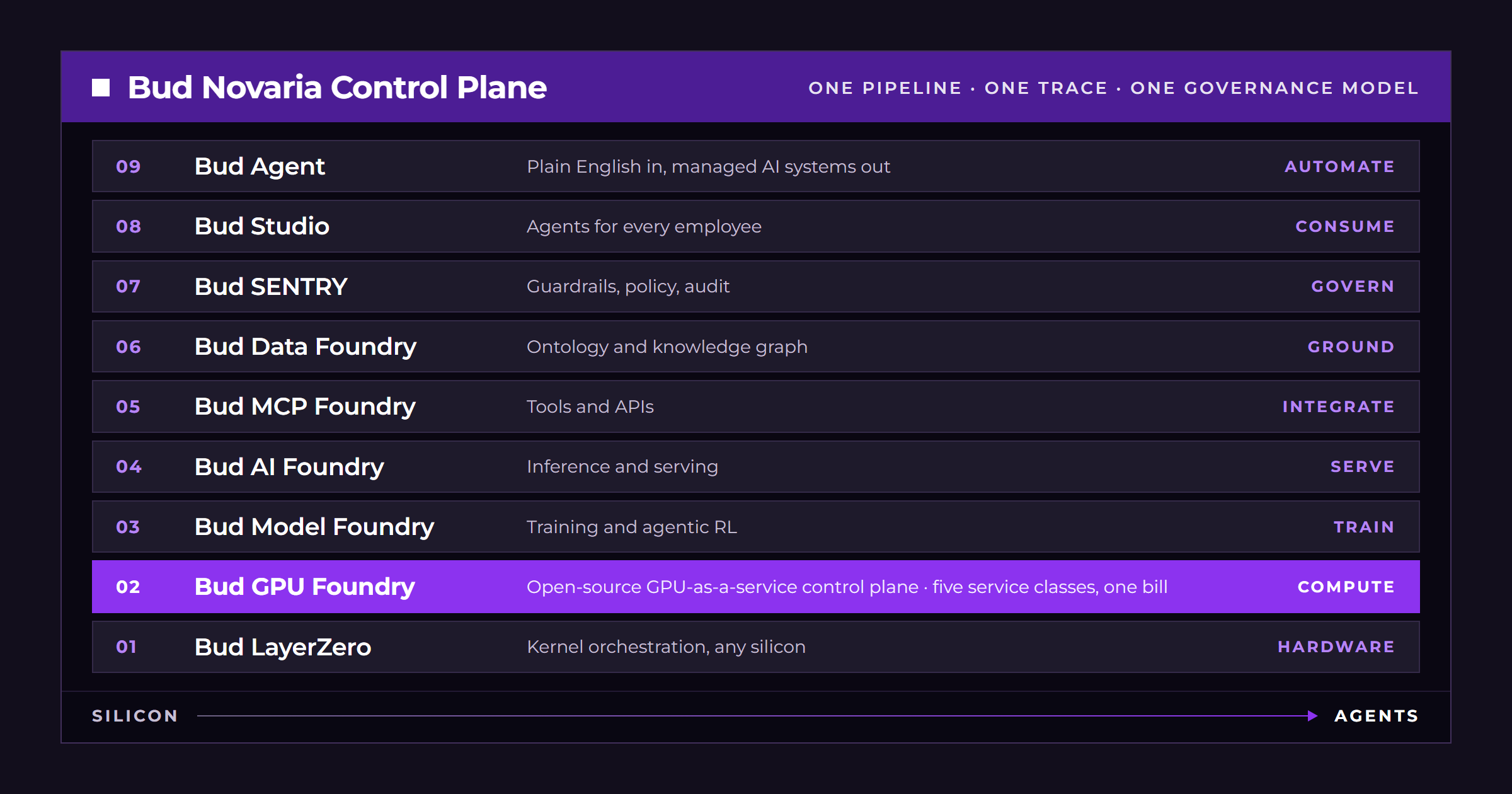

Licensed under Apache 2.0, it lets neoclouds and sovereign operators sell bare metal, VMs, Kubernetes, SLURM and serverless capacity from one fleet, on one bill
NEW YORK, NY, UNITED STATES, October 22, 2026 /EINPresswire.com/ — Bud Ecosystem today announced Bud GPU Foundry, an open-source GPU-as-a-service control plane: the software an operator uses to rent accelerators to many customers as governed services. Licensed under Apache 2.0 and installed on the operator’s own hardware, it pools NVIDIA, AMD, Intel, Qualcomm and Huawei accelerators, of mixed vendors and generations, into one fleet. That fleet is sold as bare-metal servers, virtual machines, Kubernetes clusters, SLURM clusters for high-performance computing jobs, and serverless containers. Bud GPU Foundry also replaces Bud Pod as the second of the nine layers of the Bud Novaria AI OS (AIOS), where the same capacity continues into inference, models and token-based AI services.
Accelerators are arriving faster than operators can turn them into services. Each customer wants something different: a training team wants nodes and a scheduler, a platform team wants Kubernetes, a software vendor wants a machine it can image, and a product team wants an endpoint and a price per token. Serving each one separately leaves several software stacks, several bills and no reliable answer to who used what. The software that decides who gets capacity and what they pay is usually proprietary, so operators cannot inspect the system that produces their customers’ invoices.
Bud GPU Foundry serves all of these customers from one catalog. A customer describes the shape it needs, such as four accelerators with 80 GB of memory each and a high-bandwidth interconnect. The platform selects one unit by a published rule and places the work by network topology, on one node or across many. Isolation is graded for each unit sold, from a whole bare-metal host down to a hardware partition of a single accelerator where the accelerator supports it. Customers who may compete with each other are offered only the grades that are enforced in hardware or in the network fabric. Metering starts only when the capacity is healthy and answering. Anything that fails to start is recorded at zero cost, with a reason. The usage screen and the invoice are read from the same record, so they cannot disagree. Prepaid and contract billing, spend caps, reseller organizations with customers of their own, and white-label branding are built in. An enterprise platform team running an internal GPU cloud uses the same catalog and metering to allocate capacity to business units and charge it back. Air-gapped deployment is a standard configuration; no component needs the public internet.
Inside the Bud Novaria AI OS, the capacity layer and the AI layers share one foundation. Bud AI Foundry runs on Bud GPU Foundry as an ordinary tenant, so customers billed by the token inherit the isolation, quotas and audit trail of the capacity beneath them. Capacity and tokens are metered separately but roll up through one account structure, so the margin on each endpoint is measured rather than estimated. Model training, data grounding, guardrails and agents run on the same fleet under the same permissions: one stack from silicon to agents, on the operator’s own infrastructure. The platform, including its GPU capacity layer, is in production at a sovereign cloud operator in India.
“Neocloud operators are stuck choosing between customer demand and operational reality. Their customers want Kubernetes, SLURM and high-density inference on the same hardware, but their current tools can’t unify the orchestration or the billing,” said Kevin Johnson, co-founder and COO of Bud Ecosystem. “Bud GPU Foundry bridges that gap with an open orchestration layer that turns idle capacity into billable compute.”
Bud GPU Foundry is available now. Its source code is being published under the Apache 2.0 license, and the repository link will be posted on the product page. Operators running it on its own can engage Bud Ecosystem for professional services and support packages. It is also included in the Bud Novaria AI OS license, which covers the full stack. A proof of concept runs on the operator’s own hardware: register one cluster, onboard two customers with different isolation requirements, and read the first invoice against the usage record. Full details: budecosystem.com/products/bud-gpu-foundry.
About Bud Ecosystem
Bud Ecosystem builds the Bud Novaria AI OS (AIOS): one platform from silicon to agents that unifies training, inference, routing, guardrails, governance, agents and consumption on any silicon, in any cloud, on-prem or air-gapped. Founded in 2023, Bud Ecosystem, Inc. has operations in the US and India. budecosystem.com
Rob Rollinger
Bud Ecosystem
+1 503-816-4490
Visit us on social media:
LinkedIn
Legal Disclaimer:
EIN Presswire provides this news content “as is” without warranty of any kind. We do not accept any responsibility or liability
for the accuracy, content, images, videos, licenses, completeness, legality, or reliability of the information contained in this
article. If you have any complaints or copyright issues related to this article, kindly contact the author above.

Media gallery