Cloud-Clone Primary Feline Cells: Categorised Portfolio for Full-Spectrum Veterinary Research
Diverse primary cell resources covering 14 major research fields to advance feline disease studies, pathogen research
Press Release Disclaimer: This is a press release distributed through the XPR Media network. It has not been independently verified by our newsroom.

Diverse primary cell resources covering 14 major research fields to advance feline disease studies, pathogen research and veterinary drug development
HUSTON, TX, UNITED STATES, October 14, 2026 /EINPresswire.com/ — Feline-focused veterinary science, companion-animal drug discovery and zoonotic-pathogen research are expanding rapidly worldwide. Reliable in-vitro cellular models are critical to generate biologically meaningful experimental data. Immortalised rodent or human cell lines frequently produce biased results due to inter-species differences in protein expression and signalling pathways. Primary feline cells, directly isolated from feline tissues and organs, retain native cellular phenotypes and physiological functions, closely recapitulating in-vivo microenvironments and delivering higher data fidelity and reproducibility.
Cloud-Clone has built a comprehensive primary feline cell portfolio sourced from diverse feline tissues. Cells are systematically grouped into 14 major research disciplines. This news release outlines each category, lists cell abbreviations, full denominations and typical research applications, offering clear reference for global researchers selecting appropriate cell models for feline disease mechanism investigation, pathogen characterisation, veterinary drug screening, toxicity assessment and regenerative-medicine projects.
1. Bone Research
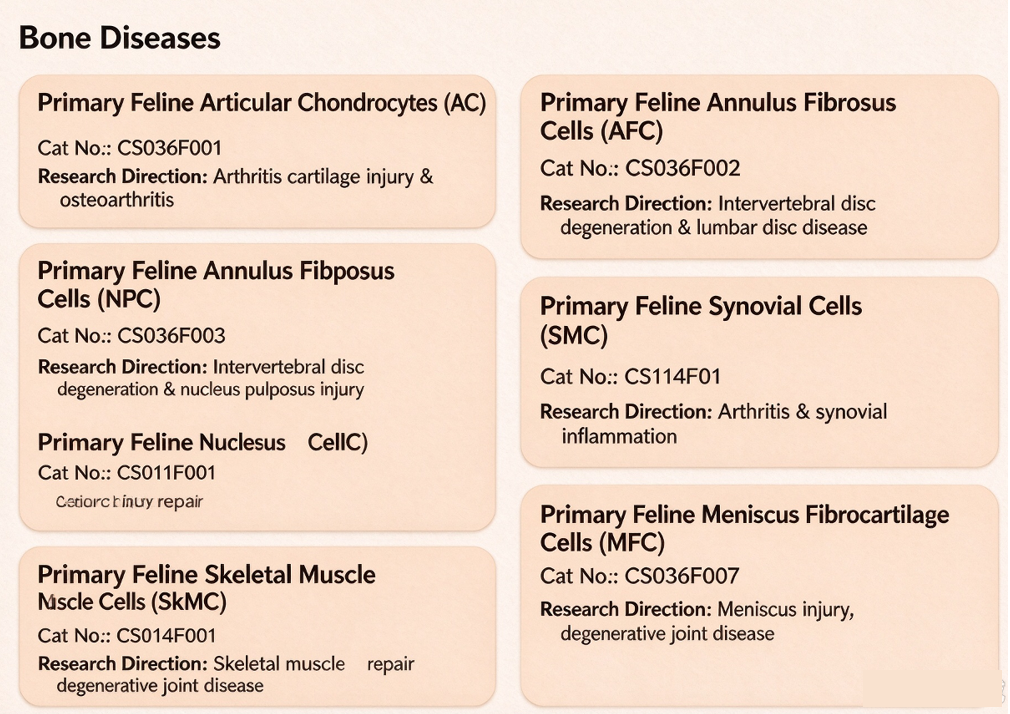
Cloud‑Clone primary feline bone-related cells are well-characterized in vitro models for skeletal physiology, bone repair, degenerative skeletal diseases and orthopaedic research. Isolated from feline bone and joint tissues, the cells preserve native bioactivities linked to bone metabolism, cartilage homeostasis, tendon and intervertebral disc function. They support studies of osteoarthritis, cartilage loss, tendon injury, muscle atrophy, disc degeneration and tissue repair. The product line includes articular chondrocytes, meniscus fibrocartilage cells, auricular chondrocytes, tendon cells, skeletal muscle cells, lingual skeletal muscle cells, annulus fibrosus cells and nucleus pulposus cells. These primary cells enable investigation of skeletal disease mechanisms, evaluation of veterinary drug candidates, and testing of regenerative biomaterials for feline bone and joint repair.
Figure 1. Primary Feline cells for bone disease research.
2. Nervous System Research
This category covers cells from central-nervous, peripheral-nerve and neural accessory tissues for physiological and pathological investigations of neurodegeneration, neural trauma and neural development. Researchers can use these models to analyse neural damage triggered by feline pathogens such as panleukopenia virus and feline coronavirus, and screen neuroprotective veterinary candidates. Available cell types include brain astrocytes, meningeal cells, sciatic-nerve peripheral fibroblasts, brain vascular pericytes, olfactory astrocytes and olfactory supporting cells.
Figure 2. Primary feline nervous-system cells for neural injury, neuroinflammation and olfactory-function studies.
3. Reproductive System Research
Primary reproductive cells facilitate research on reproductive-organ physiology and pathology, including reproductive disorders and developmental biology. Applications span oestrous-cycle regulation, follicular development, endometrial lesions and infertility-related mechanism exploration. These cell resources also enable toxicity testing and efficacy evaluation for reproduction-targeted veterinary products. The portfolio includes uterine smooth-muscle cells, ovarian fibroblasts, endometrial epithelial cells and ovarian granulosa cells.
Figure 3. Primary feline reproductive-system cells for reproductive physiology and reproductive-disorder studies.
4. Cardiovascular System Research
Age-related cardiovascular disorders are common among domestic cats. Cloud-Clone primary cardiovascular cells faithfully recapitulate feline myocardial metabolism, vascular contraction-relaxation and tissue-repair processes. They support mechanism studies for myocardial ischaemia, myocardial fibrosis and hypertensive vascular lesions, alongside pre-clinical assessment of cardiovascular veterinary agents and drug-induced cardiotoxicity or vasculotoxicity. Cell types include cardiac microvascular endothelial cells, pericardial fibroblasts, aortic smooth-muscle cells, pericardial mesothelial cells and aortic adventitial fibroblasts.
Figure 4. Primary feline cardiovascular-system cells for myocardial-injury, hypertension and vascular-lesion research.
5. Respiratory System Research
Feline respiratory tissues are highly susceptible to viral and bacterial attacks. Primary respiratory cells are utilised to study mucosal-barrier physiology, pulmonary injury repair and airway inflammation. They serve as in-vitro tools to investigate infection mechanisms of feline herpesvirus and feline calicivirus, and support antiviral and anti-inflammatory veterinary-drug screening. The panel contains pulmonary fibroblasts, tracheal smooth-muscle cells, tracheal epithelial cells and tracheal fibroblasts.
6. Digestive System Research
Digestive-system primary cells are derived from oesophageal, gastrointestinal, hepatic and pancreatic tissues. They support investigations into mucosal injury, gastrointestinal inflammation, hepatic metabolic disturbance and pancreatic pathologies. Additionally, these cells act as standard evaluation platforms for oral veterinary-drug hepatotoxicity and gastrointestinal toxicity, advancing the development of gastroprotective and hepatoprotective companion-animal therapeutics.
7. Urinary System Research
Chronic kidney disease, urolithiasis and urinary-tract infections are prevalent feline illnesses. Primary urinary-system cells enable studies on renal metabolism, renal interstitial fibrosis and urinary-tract injury and inflammation. Researchers employ these models to probe nephropathy mechanisms, test renoprotective drug effects and assess drug-related nephrotoxicity. Available cells cover renal tubular epithelial cells, renal-cortical epithelial cells, bladder smooth-muscle cells, bladder stromal fibroblasts, ureteral smooth-muscle cells and urethral epithelial cells.
8. Skin and Mucosa Research
Skin and mucosal layers constitute the first defensive barrier against external pathogens in cats. This cell collection supports research into cutaneous wound healing, burn repair, allergic dermatitis and microbial skin conditions. Use-cases include transdermal-absorption testing for topical veterinary formulations, skin-toxicity evaluation, anti-inflammatory drug screening and exploratory work for artificial-skin construction. Cell types consist of adult dermal fibroblasts, adult epidermal keratinocytes, neonatal epidermal keratinocytes, nasal-mucosal epithelial cells, nasal-mucosal fibroblasts and gingival fibroblasts.
9. Ocular Research
Feline ocular diseases exhibit distinct species-specific features. Primary ocular cells facilitate mechanistic studies of keratitis, ocular-surface damage and retinal degeneration. They are also applied for efficacy verification and toxicity assessment of ophthalmic veterinary products. Cloud-Clone’s offering includes corneal stromal cells, corneal epithelial cells and retinal pigment epithelial cells.
10. Immune and Haematopoietic System Research
Immune and haematopoietic primary cells are instrumental for dissecting feline immune responses, inflammatory signalling, haematopoietic dysfunction and immunodeficiency disorders. Researchers utilise them to examine immune-evasion strategies of viral agents such as feline panleukopenia virus and feline infectious peritonitis virus, screen immunomodulatory candidates and perform in-vitro potency assessment for vaccine prototypes. This panel comprises peripheral-blood mononuclear cells, splenic mononuclear cells and bone-marrow mononuclear cells.
11. Lymphoid and Glandular Tissue Research
Thymus, spleen and related glandular tissues govern immune-cell development, differentiation and maturation. These primary cells support studies on lymphoid-organ ontogeny, lymphatic inflammation and immune-cell regulatory networks, providing experimental material for developing immunomodulatory veterinary interventions. Cell resources include thymic fibroblasts, thymic epithelial cells and splenic fibroblasts.
12. Adipose-Metabolism Research
With rising prevalence of obesity and metabolic syndrome among companion cats, adipose-derived primary cells represent valuable experimental tools. They allow investigation of adipocyte differentiation, lipid turnover, fat accumulation and adipose-tissue inflammation. These models are suitable for validating anti-obesity and metabolism-regulating veterinary agents and nutritional supplements.
13. Endocrine-System Research
Endocrine-system primary cells are isolated from endocrine glands. They enable exploration of hormone-secretion regulation and pathological alterations induced by endocrine dysfunctions such as feline diabetes and thyroid disorders. These cell models support mechanism studies for feline endocrine illnesses and screening of hormone-modulating veterinary candidates.
14. Stem-Cell Research
Primary feline stem cells feature robust self-renewal capacity and multi-lineage differentiation potential. They are applied in cutting-edge regenerative-medicine research covering tissue-injury repair, organ regeneration and cell-therapy development. These resources advance pre-clinical studies for companion-animal trauma recovery and innovative biological therapeutic approaches.
Cross-species experimental artefacts are a key challenge in feline biomedical research. Cloud‑Clone offers a broad portfolio of primary feline cells covering 14 major research fields. Generated via validated tissue isolation, gradient digestion, purification and culture processes under rigorous QC, these primary cells maintain native biological features with high viability and purity, ensuring reliable, repeatable experimental results.
This product range supports varied global research applications: basic veterinary mechanistic studies, feline pathogen isolation and characterization, vaccine development, antiviral drug screening, veterinary safety assessment, and regenerative medicine research. Researchers worldwide may select suitable cell models to reduce cross-species bias and advance feline life science studies.
For specifications, technical data and ordering details of Cloud‑Clone primary feline cells, please reach out to our global sales and technical support team.
About Cloud-Clone Corp.
Cloud-Clone Corp. is dedicated to the development and production of high-quality immunoassay reagents and detection solutions. With a focus on antibody engineering, multiplex assay development, and cross-platform compatibility, the company provides research tools designed to support precision medicine and advanced biomedical investigation globally. Our core products and services include the research and development of proteins, antibodies, ELISA kits, primary cells, and multiplex cytokine assay kits, as well as professional CRO services to fully meet the diverse needs of biomedical research and related fields.
For more information about Cloud-Clone Corp, visit www.cloud-clone.com.
CLOUD-CLONE CORP.(CCC)
Tel: 001-832-538-0970, 0086-27-8425-9552
Email: mail@cloud-clone.com, sales@cloud-clone.us
Visit us on social media:
LinkedIn: https://www.linkedin.com/company/cloud-clone-corp/
Instagram: https://www.instagram.com/cloudclonecorp2023/
TickTok: https://www.tiktok.com/@cloudclonecorp2026
SuKi Duan
CLOUD-CLONE CORP.WUHAN
Visit us on social media:
LinkedIn
Instagram
TikTok
X
Legal Disclaimer:
EIN Presswire provides this news content “as is” without warranty of any kind. We do not accept any responsibility or liability
for the accuracy, content, images, videos, licenses, completeness, legality, or reliability of the information contained in this
article. If you have any complaints or copyright issues related to this article, kindly contact the author above.

Media gallery