
Frank Igwealor’s IGBO IDENTITY, A New Book Asks How the Igbo Became One of Africa’s Most Recognizable People
Frank Igwealor’s IGBO IDENTITY walks the reader through Ndi Igbo society from Igbo-Ukwu bronzes to the 2027 elections
Press Release Disclaimer: This is a press release distributed through the XPR Media network. It has not been independently verified by our newsroom.
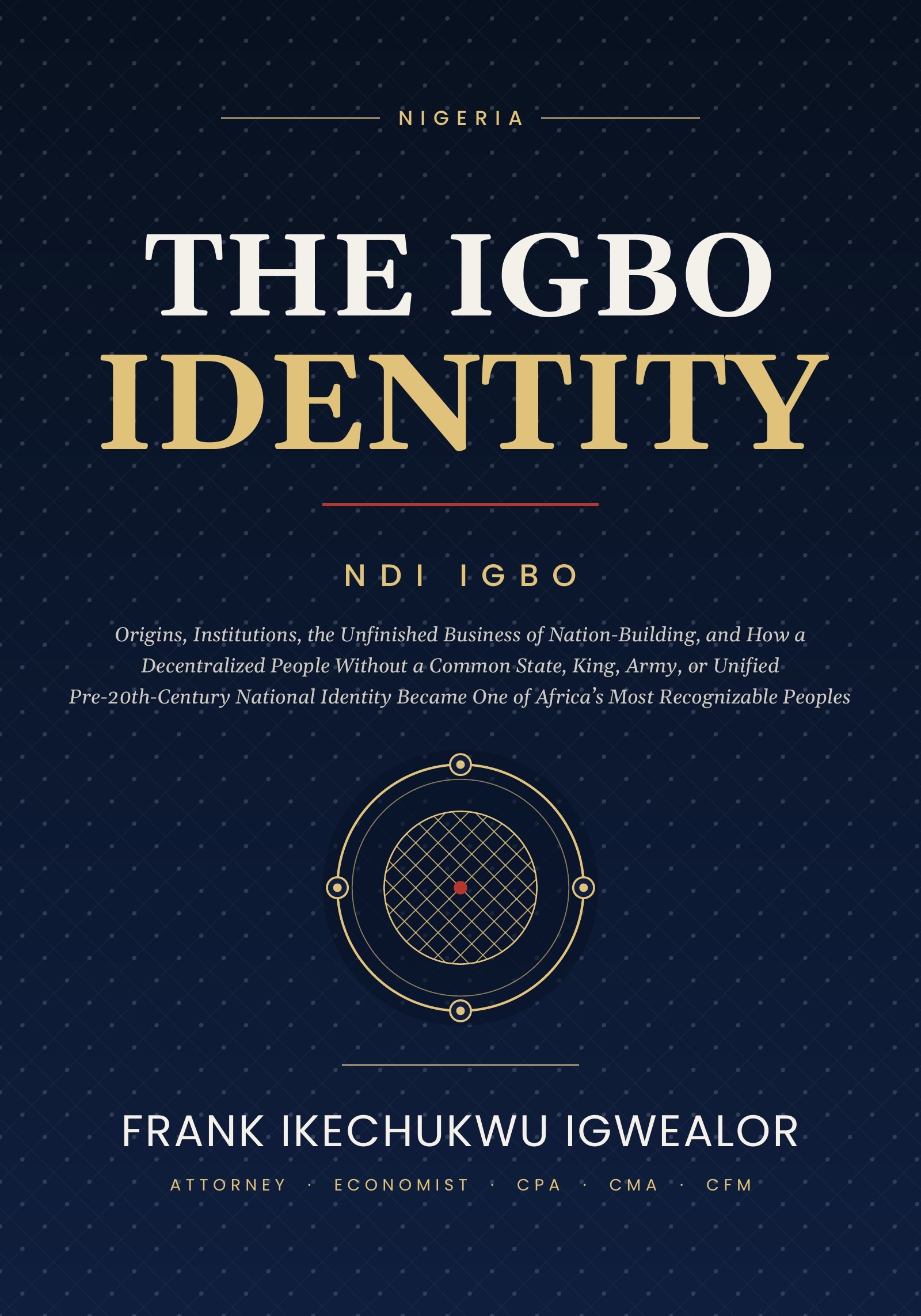

Frank Igwealor’s IGBO IDENTITY walks the reader through Ndi Igbo society from Igbo-Ukwu bronzes to the 2027 elections without celebration or indictment
LOS ANGELES, CA, UNITED STATES, September 12, 2026 /EINPresswire.com/ — Frank Ikechukwu Igwealor, attorney, economist, and author, today announced the release of The Igbo Identity, a study of one of Africa’s most discussed and least carefully examined peoples. Across nineteen parts and 115 chapters, it runs from the ninth-century bronzes of Igbo-Ukwu to the Nigerian census dispute, the Nnamdi Kanu proceedings, and the approach of the 2027 elections.
A Genuine Puzzle, Not a Rhetorical One
At the center of the book is a paradox. The people now known collectively as the Igbo historically had no common king, no capital, no central government, and no standing army. They governed themselves through lineage, village assembly, age grade, and oracle. Yet within a single century they emerged as one of the continent’s most recognizable nations — and their position inside Nigeria remains unresolved nearly sixty years after a war was fought over it.
Igwealor is explicit that he is not writing a tribute. He describes, and declines to write, the easier book that would assemble Igbo achievements and present the assembly as an argument.
“Books of that kind are written regularly, in Nigeria and elsewhere, about every people large enough to sustain a publishing market,” he writes. “They are read almost exclusively by the people they flatter, and they are dismissed by everyone else on sight, correctly, as advocacy.”
Institutions, Not Character
The book’s central explanatory claim is that Igbo outcomes are produced by institutions and circumstances rather than by inherited temperament. Two facts carry most of the weight: extreme population density on the smallest zone in the federation, and the destruction between 1901 and 1920 of the four institutions capable of coordinating above the village.
From density the book derives land scarcity, migration, the commercial orientation of the trading cities, the igba boi apprenticeship system, and the absence of centralized states. From the collapse of supra-local authority it derives the coordination problems that run through modern Igbo politics. The argument cuts against admirers and critics alike: the Igbo are neither enterprising nor politically incoherent by nature, and the institutions producing those outcomes are datable and changeable.
Nothing Omitted for Comfort
The book applies a declared five-tier hierarchy of evidence, from documented records through scholarly reconstruction and oral tradition to widely repeated popular claims. Four rules govern it: no figure without its source, date, and method; no tradition promoted to history; live matters written so that any outcome leaves the text accurate; and no omission for comfort.
That last rule is applied against the author’s own subject. The book examines the Aro network’s supply of captives to the Atlantic trade, the osu caste system that survives in practice despite its 1956 abolition, the weekly sit-at-home enforced by armed men on a population that does not want it, the record of five state governments over fifty years, and the decline of the Igbo language.
The same standard applies to grievance. Several specific claims animating Igbo politics survive contact with the evidence: a state-count disadvantage that is arithmetic rather than motivated, an indigeneity system that makes permanent strangers of Nigeria’s most mobile population, and a war whose dead were never counted, tried, memorialized, or taught.
“A country that will not describe what it did to a tenth of its own population has not finished the war,” Igwealor writes. “It has stopped fighting it.”
The final chapter sets out what is owed to the Igbo, what the Igbo owe Nigeria, and what they owe one another — three lists, stated with equal plainness.
For Readers Coming from Any Direction
The book covers Igboland’s geography and subgroups; competing accounts of origin, including a chapter-length assessment of the Israelite origin claim; odinani and the Christian transformation; language, proverbs, and nsibidi; kola, marriage, burial, and masquerade; markets and apprenticeship; Olaudah Equiano and Igbo Landing; colonial conquest and the Women’s War of 1929; 1966, Biafra, and the blockade; the marginalization debate; IPOB and the present crisis; the population controversy; and the global diaspora.
A practical section for visitors explains etiquette, address, sensitive subjects, and twelve concepts that make Igbo life legible to an outsider. Fourteen appendices supply timelines, glossaries, proverbs, tables of contested claims, and side-by-side comparisons of competing casualty and population estimates. Roughly two thousand cross-references and a full index let readers enter at any point.
Book Details
Title The Igbo Identity
Subtitle Ndi Igbo — Origins, Institutions, the Unfinished Business of Nation-Building, and How a Decentralized People Without a Common State, King, or Army Became One of Africa’s Most Recognizable Peoples
Author Frank Ikechukwu Igwealor
ISBN 979-8-951213-15-0
Length 19 parts, 115 chapters, 14 appendices, index
Availability Amazon: https://www.amazon.com/dp/B0HJFRLL31
About the Author
Frank Ikechukwu Igwealor is an economist, a California-licensed attorney, a Certified Public Accountant, Certified Management Accountant, and Certified Financial Manager, and has been a California-licensed real estate broker since 2005. He holds degrees in accounting, economics, business administration, risk management, and law, and has served as an officer and director of public and private companies in the United States, Europe, Asia, the Middle East, and Africa. He has written more than twenty books on economics, politics, history, faith, and finance, including The Roots of African Poverty, The God of Abraham, Isaac, and Israel, and African Development Paradox. He lives in Los Angeles, where he also pastors a small charismatic congregation.
Frank Ikechukwu Igwealor
Frank Ikechukwu Igwealor, CPA, CMA, CFM, ESQ.
email us here
Legal Disclaimer:
EIN Presswire provides this news content “as is” without warranty of any kind. We do not accept any responsibility or liability
for the accuracy, content, images, videos, licenses, completeness, legality, or reliability of the information contained in this
article. If you have any complaints or copyright issues related to this article, kindly contact the author above.

Media gallery
